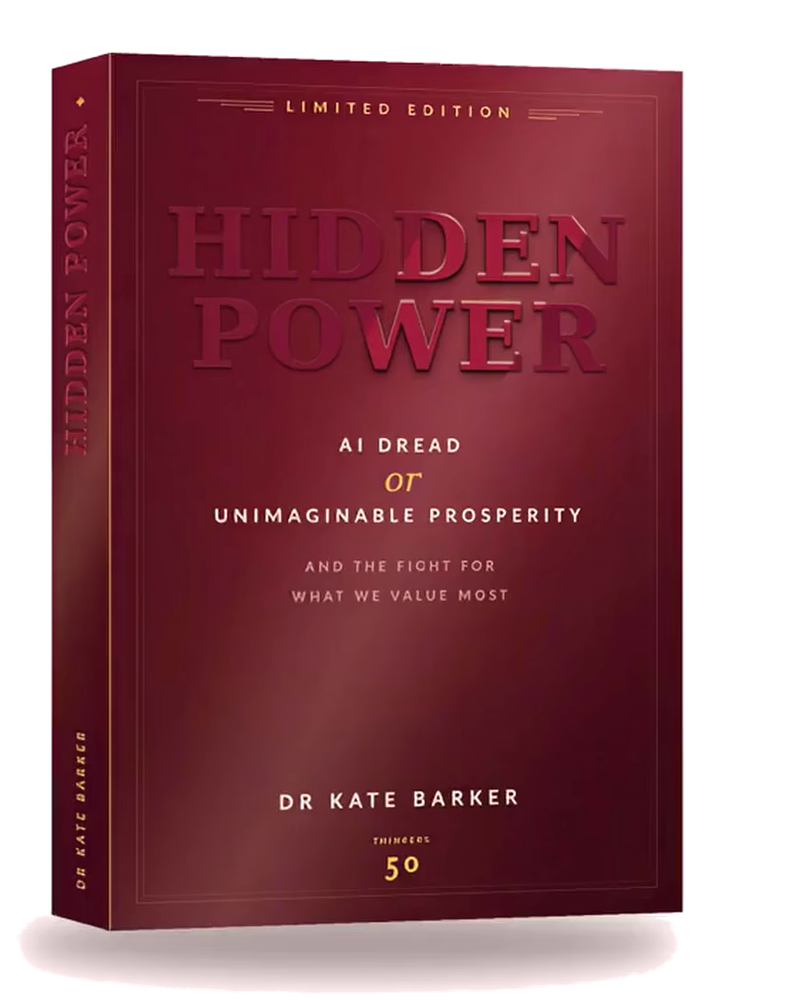
Hidden Power
AI Dread or Unimaginable Prosperity and the Fight for What We Value Most
Published by Amplify, in association with Thinkers50. Publishing 1 March 2027.
Every board in the world is racing to adopt AI. Almost none of them can answer the only question that matters: what happens to the humans who decide?
The night the missiles came, I was at dinner on the 24th floor of The Link at One Za’abeel. The news moved across every phone at the table, and the remarkable thing was that the room kept going. Deals kept being discussed. Introductions kept being made.
Somewhere over the Gulf, the world was changing shape, and forty of the most powerful people in the region simply absorbed it and carried on.
That is where this book begins, because that is what the AI era actually feels like from inside the rooms where the decisions get made. The extraordinary has become ambient. The signals never stop. And the leaders who win are not the ones who react fastest to what is racing across the table. They are the ones who can still tell which of it matters.
ADVANCE PRAISE
Kate Barker shifts the AI debate. Hidden Power is a compelling guide for leaders who intend to shape the AI era, not simply submit to it.
Des Dearlove & Stuart CrainerCo-founders, Thinkers50, United Kingdom Hidden Power asks the question every board and senior leader should now be confronting: as artificial intelligence becomes more powerful, who remains genuinely in control? Kate Barker offers a compelling and timely argument for protecting human judgement, accountability and institutional autonomy in an age when technological capability is advancing faster than our capacity to govern it.
Professor Nada KakabadseHenley Business School, United Kingdom Every leader is running outdated code. Barker’s Hidden Power is the upgrade: a case for protecting the Human Operating System before AI decides it’s obsolete. Essential reading.
Dom PriceWork Futurist, Atlassian, Australia Kate approaches the defining challenge of our lifetime, AI, in a truly intriguing way. Her unique vantage point into how institutions and states operate and her frameworks for shaping their transformation for this new era make for an insightful and compelling read.
Ravin JesuthasanFuturist and bestselling author; author of the forthcoming Navigating the Intelligent Age (MIT Press, 2027), USA
Further endorsements from confirmed contributors, including H.E. Omar Sultan Al Olama, UAE Minister of State for Artificial Intelligence (United Arab Emirates), and Gary Bolles, Chair for the Future of Work, Singularity University (USA), will appear ahead of publication.
The scenes that made me write it
I have spent years inside boardrooms on four continents, from sovereign wealth committees in the Gulf to technology boards in Europe and North America, and the same scenes kept repeating until I could no longer pretend they were exceptions.
A chair asks her board a simple question: now that the AI programme is live, who owns the decisions it makes? The silence lasts eleven seconds. I counted. The programme moves two billion dollars of exposure, it was approved eight months earlier, and not one person at that table can say where the accountability went. It didn’t disappear. It moved. And nobody in the room knows where.
An executive team spends an hour agreeing enthusiastically on a strategy. Then, one by one and in confidence, five of the seven tell me they think it will fail. The alignment I watched was a performance staged for the machine-made numbers on the screen. The strategy everyone applauded has no owner and five quiet opponents, and it is about to consume three hundred million dollars.
A chief executive, one of the most impressive people I have worked with, reads a recommendation to his board with total conviction, and halfway through I realise he is not summarising his judgement. He is reciting the model’s. He has stopped noticing the difference. His brilliance is exactly what makes it invisible, because everyone in the room assumes the thinking is his.
If any of that feels familiar, it should. It is happening in your organisation right now.
The uncomfortable truth
The advantage in the AI era does not go to whoever adopts the technology fastest. Adoption is now table stakes; your competitors have the same models you do. The advantage goes to the boards and chief executives who can still think clearly when the machine sounds certain, because as AI makes capability abundant, what becomes scarce is stubbornly human: the judgement to know when a persuasive answer is wrong, the cognitive agency to remain an active thinker rather than a fluent approver, and the relationship capital that carries a hard decision through an organisation when the data alone cannot. That is the hidden power. Most institutions are trading it away without noticing, and they will not discover the cost until a decision that mattered goes wrong with nobody’s hands on it.
What you will take from it
By the last page you will know where accountability actually sits in your AI-enabled decisions, and where it has silently moved. You will know how to spot performed alignment before it costs you, and how to tell when a leader’s conviction is borrowed from the machine. And you will hold the two instruments I use inside those rooms: the Board AI Index, which maps an institution’s readiness and oversight across five levels from Reactive to Integrated, and the Executive Cognitive Advantage Index, which maps the five human dimensions on which a leader’s performance now turns. The stories are mine. The evidence is bigger: doctoral research across six thousand executive leaders worldwide, and advisory work spanning heads of state, sovereign programmes and more than one hundred Fortune 500 companies.
Who it is for
Chairs and boards governing AI-enabled transformation. Chief executives deciding what to hand to the machine and what to keep human. Sovereign and institutional leaders whose decisions must stand up to scrutiny operationally, reputationally and historically. If you have ever sat in a meeting where everyone agreed and nothing was true, this book was written in that room.
About the author
Dr Kate Barker is the executive advisor the advisors call. Three decades of global practice advising chief executives, boards and the consulting partners who advise them, underpinned by a master’s in organisational psychology and a doctorate on what generative artificial intelligence does to organisational trust. She counsels heads of state, boards and global chief executives on AI transformation, policy and the psychology of leadership. A TIME100 AI Impact Award honouree, the world’s first Chief Futurist, and Professor of Practice in AI at Mohamed bin Zayed University of Artificial Intelligence (MBZUAI), UAE. Hidden Power is her first book.
Hear when it lands.
Begin with a confidential conversation.
For Board Advisory, Strategic Consulting, Keynote Speaking or Private Executive Advisory enquiries, please write with a short note on the decision, audience or transformation context. Suitable engagements are shaped through an initial private conversation.